Food Noise, Cravings, and the Truth About Huger
Why Willpower Isn’t the Answer—and What Your Body May Be Trying to Tell You
If you have ever felt like you are constantly thinking about food, battling cravings, trying to “be good,” and then feeling frustrated when your willpower runs out… you are not alone.
And more importantly?
It may not be your fault.
That is exactly what we explored in this conversation on The Synergee Podcast with Sarah Kennedy, CEO of Calocurb, a company focused on plant-based appetite support and metabolic health. What unfolded was a fascinating, science-backed conversation about appetite, food noise, hormones, gut health, and why so many women feel trapped in a cycle of restriction, cravings, and self-blame.
Let’s talk about it.
What Is “Food Noise,” Really?
Food noise is that constant mental chatter around food.
It is thinking about what you are going to eat, what you should not eat, whether you are hungry, whether you should wait longer, whether you “deserve” something, whether you have ruined the day already, and whether you should just start over tomorrow.
It is exhausting.
And for many people, it takes up way more mental and emotional energy than they even realize.
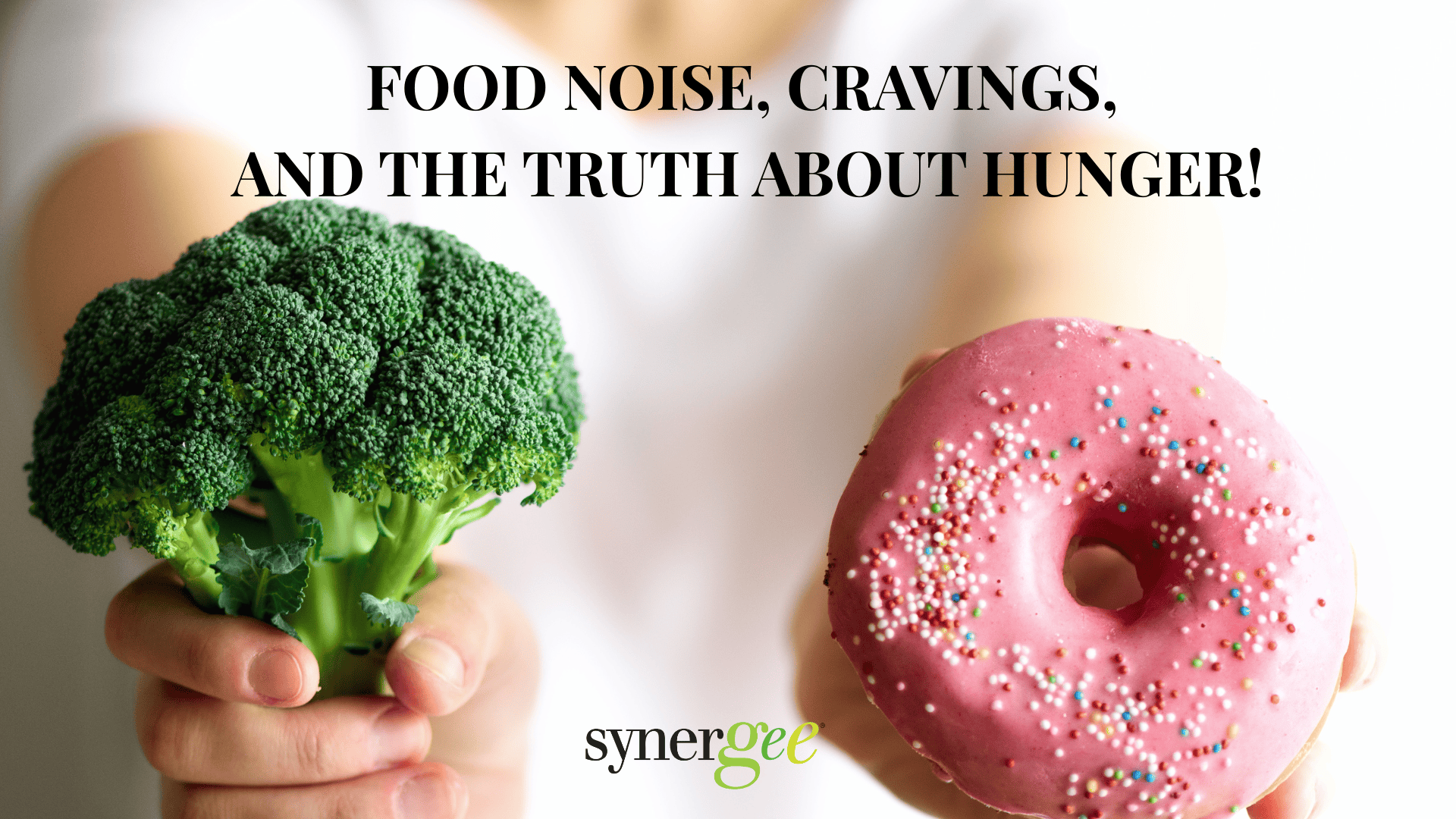
This is one of the reasons conversations around appetite matter so much. Because when your body is sending strong hunger cues, craving signals, or mixed messages, it is incredibly hard to “just eat less” and carry on like everything is fine. That constant internal pull can leave you feeling distracted, defeated, and disconnected from your own body.
Hunger Is Not a Character Flaw
One of the most important points from this episode is this:
Hunger is a biological survival mechanism.
Your body is designed to protect you. From an evolutionary standpoint, hunger helped keep humans alive. If calories dropped too low for too long, hunger increased so you would go find food. That response was protective then, and it is still protective now.
The problem is that we are trying to apply ancient biology to a modern world full of ultra-processed foods, constant temptation, chronic stress, poor sleep, and messaging that tells women to ignore their bodies and just “have more discipline.”
That disconnect creates a lot of shame.
So many women have been taught to believe that if they are hungry, craving, gaining weight, or struggling to stay consistent, they must be doing something wrong. But often, what they are experiencing is physiology—not failure.
Restriction Often Backfires
We see this all the time in practice.
Someone starts cutting calories. They try to be “good.” They push through hunger. They white-knuckle it for a while. And then eventually the cravings get louder, the food thoughts get stronger, and the whole thing feels impossible to sustain.
Why?
Because your body adapts.
When you restrict food intake, your hunger can increase. Your body does not interpret long-term calorie restriction as a wellness plan. It often interprets it as a threat. That can amplify hunger, increase preoccupation with food, and make it harder to feel satisfied.
So when someone says, “I know what to do, I just can’t seem to do it,” we really need to pause before blaming behavior alone. Sometimes the body is fighting hard to maintain survival, and unless we address the physiology underneath, the cycle keeps repeating.
Your Gut Plays a Bigger Role in Appetite Than You Think
This is where the conversation gets especially interesting.
Most people think hunger starts in the brain only. But appetite is deeply connected to the gut.
Your gastrointestinal tract helps regulate hormones that influence fullness, satisfaction, and appetite control. In the episode, Sarah explained how certain receptors in the gut—particularly bitter taste receptors—appear to play a role in stimulating appetite-regulating hormones like:
* GLP-1
* CCK
* PYY
These hormones help send signals that you have eaten, that you are satisfied, and that you do not need to keep seeking more food.
That matters, because when those signaling pathways are not working optimally, it can feel like your body never really gets the memo that enough is enough.
And for women dealing with stress, perimenopause, sleep issues, blood sugar swings, inflammation, and gut dysfunction, this signaling can get even messier.
GLP-1 Is Not Just a Buzzword
You have probably heard a lot about GLP-1 lately.
Usually, the conversation centers around injectable medications. But GLP-1 is not just a trendy term—it is a hormone your body naturally makes, especially in the gut, and it plays a role in appetite regulation, blood sugar balance, and satiety.
That means your body already has built-in systems designed to help regulate hunger.
The question is not just whether you can suppress appetite. The deeper question is:
How do we support the body’s own ability to regulate appetite well?
That is where the discussion becomes much more nuanced and much more empowering.
Because instead of seeing hunger as the enemy, we can start looking at how to support the systems involved in hunger signaling in the first place.
Fullness and Satiety Are Not the Same Thing
This is such an important distinction.
You can feel physically full and still not feel satisfied.
You can eat a large volume of food and still find yourself craving something else.
That is because satiety is not just about how much food is in your stomach. It is about the hormonal, neurological, and metabolic experience of feeling nourished and complete after a meal.
When satiety is off, people often keep chasing something they cannot quite reach. More crunch. More sweet. More snacks. More bites after dinner. Not because they are weak—but because the body is not receiving or responding to the right signals.
That “never quite satisfied” feeling is one of the most frustrating parts of dysregulated appetite.
Why This Hits Women So Hard in Midlife
Women are often hyper-aware of their bodies from a very young age. Then add the hormonal shifts of perimenopause and menopause, and the game changes again.
As estrogen shifts, muscle mass can decline, metabolic flexibility often worsens, sleep may suffer, stress resilience drops, and body composition starts changing in ways that feel confusing and discouraging.
The tools that used to “work” in your 30s and 40s suddenly stop working.
That can feel deeply personal. But it is often deeply physiological.
This is one reason we talk so much about foundation in our practice. Before blaming yourself, before jumping to extremes, before assuming you are failing, we have to ask:
* How is sleep?
* How is stress?
* How is gut health?
* How is blood sugar?
* How is protein intake?
* How is muscle mass?
* How are hormones shifting?
Because the body does not exist in a vacuum. Appetite is connected to all of it.
Food Freedom Does Not Mean Ignoring Biology
We loved that this episode reframed freedom in a smarter way.
Freedom is not forcing yourself to override your body all day.
Freedom is not pretending you do not care about food.
Freedom is not living on black coffee, determination, and tiny portions.
Real freedom comes from understanding your biology well enough to work with it instead of constantly fighting against it.
That means respecting the foundation:
* gut health
* nutrient density
* sleep
* blood sugar balance
* stress response
* muscle preservation
* hormone support
* movement
* individualized care
And when appropriate, it may also mean using tools.
Not shortcuts.
Not magic.
Not one-size-fits-all fixes.
Tools.
A good tool used at the right time, in the right person, within the context of a bigger plan, can be incredibly helpful. But no tool replaces the foundation.
There Is No Prize for Suffering
We say this with love: women have been taught to suffer through way too much.
To ignore their hunger.
To dismiss their symptoms.
To assume their body is broken.
To believe that if they were stronger, leaner, more disciplined, or more motivated, everything would finally click.
But health is not supposed to be built on punishment.
And if your body is sending loud signals—whether that is food noise, cravings, unstable hunger, low energy, poor recovery, or stubborn weight changes—those signals deserve curiosity, not shame.
The Bigger Takeaway
What we hope listeners take from this conversation is this:
You are not lazy.
You are not failing.
You are not lacking willpower.
Your body may simply need support.
When appetite is dysregulated, when food noise is constant, and when cravings feel relentless, the answer is rarely more self-criticism. The answer is understanding the why.
That is where healing begins.
Because once you understand the physiology, you stop making everything a moral issue.
And that shift alone?
That can be incredibly freeing.
Final Thoughts
If you have been stuck in the cycle of restricting, craving, overeating, regretting, and starting over, let this be your reminder that there is another way.
A more compassionate way.
A more informed way.
A more physiologic way.
One that honors the fact that your body is always communicating—and that the path forward is not about overpowering it, but about learning how to listen.
That is where calm starts to return.
That is where confidence begins to rebuild.
And that is where real freedom with food can begin.